WARC world model learns unseen ARC-AGI-3 game rules while it plays
WARC, a 35M-parameter world model, keeps training during play and learns most rules of unseen ARC-AGI-3 games. Code and weights are out under CC0.
· 3 min read · By Efe Anidi
On this page +
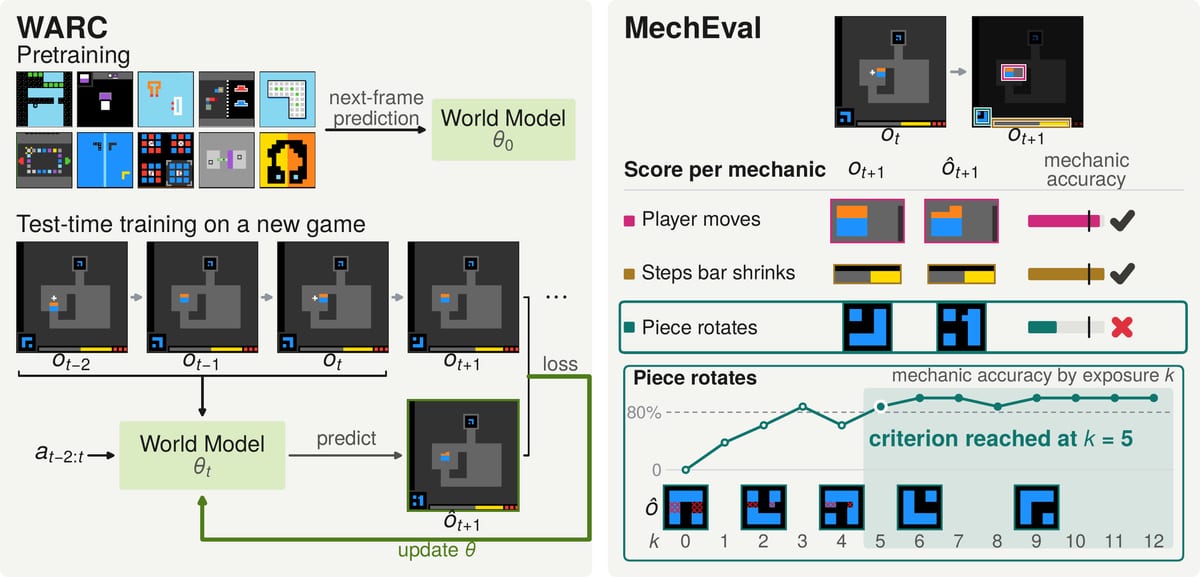
On 9 November 2026, a team from Third Intelligence, Inc. and the University of Tokyo posted a paper on WARC to arXiv. WARC is a 35-million-parameter world model that learns the rules of a game it has never seen by keeping on training while it plays. The paper is titled “How Many Exposures Does a World Model Need? Learning Unseen Game Mechanics at Test Time”, and the code and weights came out alongside it under a CC0 licence. The tests use ARC-AGI-3. That benchmark, which the ARC Prize Foundation released on 25 March 2026, is made up of hand-built, turn-based game environments that give the player no instructions, no rules and no stated goals.
What the paper measures
World models are usually scored on how well they predict the next frame of an environment they already know. This paper asks a different question: dropped into an unfamiliar game, how many times does a model have to see a rule in action before it can predict that rule reliably?
The authors call each rule a mechanic. One example from the paper is a block that slides when the player pushes it. Each time the model sees a mechanic happen counts as one exposure. To count exposures, they built MechEval, which labels 69 recurring mechanics across 20 of the 25 public ARC-AGI-3 games. A mechanic counts as learned from the exposure at which the model’s accuracy on the cells that mechanic changes reaches 80% and stays there.
How WARC performs
WARC is pretrained on a subset of the public games and then tested on games it never saw in training. During play it updates all of its parameters after each move, using 20 gradient steps per update. The results:
- With updates during play: four in five mechanics reach the 80% bar. Half of those get there within about 80 exposures, inside a single playthrough. The paper’s results table puts the median at 74 exposures.
- Frozen, with no updates: only one mechanic in seven reaches the bar.
- Inside an agent: combined with a graph-based explorer, the resulting WARC-Agent raises the official ARC-AGI-3 efficiency score from 0.15 to 0.46. The authors credit most of that gain to the training during play.
- Kaggle: an entry built on a model pretrained on all 25 public games scored 0.20 on the competition’s public leaderboard. That leaderboard uses half of the hidden games.
An ablation in the paper found that a low-rank LoRA update performs about as well as updating every weight.
Why it matters for simulation and world-model builders
Many generative world models are trained once and then frozen, so a rule they never saw in training stays a blind spot. WARC tests the opposite approach and measures what it gains: keep learning during play, and count exactly how much experience each new rule takes. If you build game simulators, agent sandboxes or interactive story worlds where players can bring in new rules, the exposure counts give you a concrete benchmark to compare against.
The GitHub repo includes the model, the training code and four checkpoints. Three of the checkpoints are the per-fold models used in the paper, and the fourth is the all-games model from the Kaggle entry. The weights are hosted on Hugging Face, so you can rerun the experiments or retrain on other grid-style games.
Limits and what is still unknown
The efficiency gains look large as ratios but are small in absolute terms. The official score runs from 0 to 100, and even the paper’s oracle, a world model that always returns the true next frame, only takes the explorer to about 1.4. WARC also doesn’t play by itself: every agent result depends on the explorer it is paired with. One in five mechanics never reaches the 80% bar.
The MechEval annotations and scorer are still unticked in the repo’s release plan, so outside researchers can’t yet check the mechanic-level numbers on their own. The paper is a single v1 preprint, labelled for the ARC Prize 2026 Paper Track, and it hasn’t been peer reviewed.
Questions and answers
What is WARC?
WARC (World model for ARC-AGI-3) is a 35-million-parameter vision transformer described in a November 2026 arXiv paper by Ku Onoda, Haruto Kawano, Shota Takashiro and Kohei Hayashi. It predicts the next frame of an ARC-AGI-3 game, and it keeps fine-tuning itself on each new move while it plays a game it was not trained on.
What is MechEval?
MechEval is the evaluation introduced in the same paper. It labels 69 recurring mechanics across 20 of the 25 public ARC-AGI-3 games. A mechanic is a rule for how an action or interaction changes part of the game. MechEval scores a model's prediction each time a mechanic occurs. The authors say they will release its annotations and scorer, but these were not yet public at launch.
Can I use WARC today?
Yes. The model code, the pretraining and test-time training code, the exploration agent and four checkpoints are on GitHub under a CC0 1.0 licence. The weights are on Hugging Face. Bundled third-party components keep their own MIT licences.
Does WARC solve ARC-AGI-3?
No. WARC models how a game's rules behave, and it needs an exploration agent to play. With that agent, its best official efficiency score on the public games is 0.46, and its Kaggle public-leaderboard entry scored 0.20. That score runs on a 0–100 scale.
Sources: